Competitive research can tell you a lot about a category, but it does not always make the next marketing move obvious. In this post, we will use SitecoreAI to show how competitive intelligence can be translated into a clearer positioning strategy. Using a sample healthy snack brand called POWERFUL, we started with Competitor Analyzer Agent to identify the strongest competitive threats, crowded category claims, and the most credible whitespace opportunities.
We then used Market Signals Agent to test whether that positioning was actually supported by market momentum and consumer behavior. The goal was to move beyond a list of competitors and arrive at something marketers can use: a sharper strategy, clearer messaging, and practical ideas for content and website planning. What emerged was a more actionable view of how POWERFUL could compete by owning real-life “bridge snack” moments with a non-stimulant, satisfying energy promise.
This was an AI-assisted strategy exercise using a sample brand kit, so the value here is in how quickly the workflow surfaces strategic direction—not in treating every output as final market truth.
The business scenario
POWERFUL is a healthy energy snack brand competing in a crowded category that includes bars, granola, and other on-the-go snacks. Its goal is to offer clean, sustained energy for athletes, active consumers, and busy professionals, but that also puts it up against well-established brands with strong claims around wellness, performance, and convenience.
That makes POWERFUL a useful example for exploring how SitecoreAI can help marketers move from broad category research to a clearer strategic direction.
The challenge
Like many brands, POWERFUL is entering a market where the most common claims are already familiar: clean ingredients, protein, low sugar, convenience, and wellness. The challenge is not just having a good product story, but finding a positioning that feels more specific, credible, and memorable than what competitors are already saying.
For marketers, that creates a practical problem: how do you move from broad competitor research to a strategy that can actually shape messaging, content, and website decisions? That is the gap this exercise was designed to close.
SitecoreAI in action
To make this exercise practical, we ran it as a two-step workflow inside SitecoreAI. We started with Competitor Analyzer Agent to understand the competitive landscape and define a strategic direction, then added Market Signals Agent to test whether that direction was actually supported by category momentum and consumer behavior.
That flow matches how the agent is designed to work: you provide a competitive analysis request, optionally add context, attach a brand kit, and then continue building on the work inside the same space with additional agents and artifacts
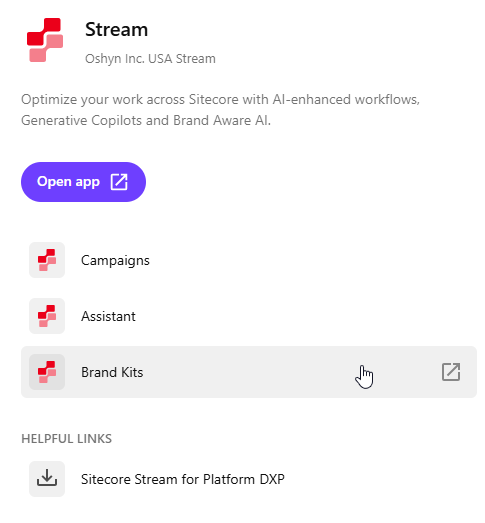
Step 1: Build the brand kit in Sitecore Stream
The workflow started in Sitecore Stream, where we created the POWERFUL brand kit and uploaded the source documents that define the brand. In Stream, those uploaded files become the foundation of the brand knowledge that Sitecore AI uses later, so this step is what grounds the analysis in actual brand material rather than only in prompt instructions.
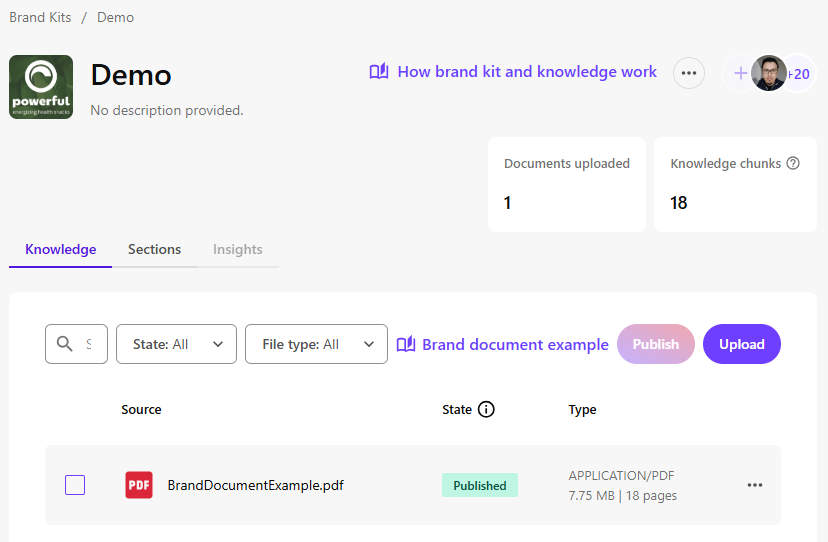
On the Knowledge tab, upload the PDFs that make up the brand kit. After upload, the files appear with Draft status, and Stream uses them to extract and generate brand knowledge. When the brand kit is published, that ingestion process is completed and the brand kit becomes ready for AI tools to use.
Step 2: Run Competitor Analyzer using the brand kit
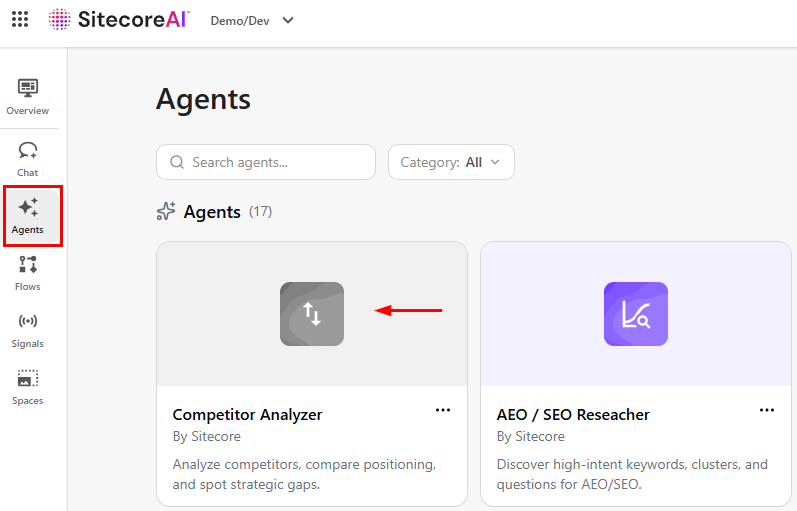
Open Agentic studio in SitecoreAI
Click Agents and Select Competitor Analyser
Create a New Space by filling the Space Title, and selecting the Brand Kit as the Context.
Then, Click Create
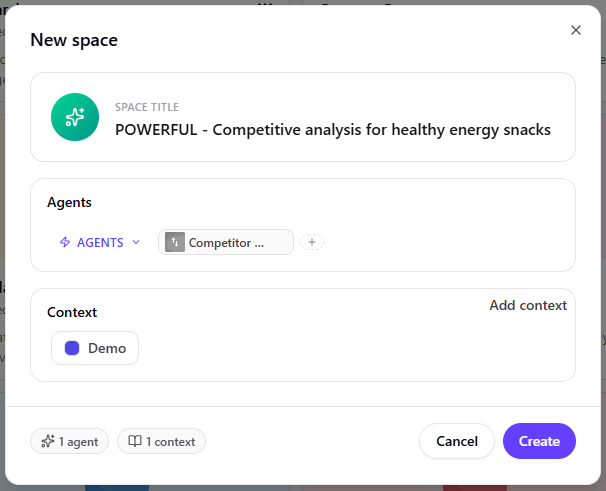
Now that the space is created we’ll execute the Agent using the following prompts to define the analytical scope, the desired output, and a few guardrails to keep the agent focused on bars and granola rather than narrowing the brand too much.
Competitive Analysis Request prompt
Analyze the competitive landscape for POWERFUL and provide an execution-oriented strategic output.

For this analysis, treat POWERFUL as a broader healthy energy snack brand spanning:
- energy bars
- protein bars
- granola
- granola bars
- adjacent healthy energy snacks where relevant

I do not want a generic category overview. I want a practical strategic analysis that can inform marketing decisions.

Please provide:
1. The main competitor categories and the most relevant brands in each
2. The top competitors most relevant to POWERFUL across bars and granola/granola bars
3. A ranked list of the strongest competitive threats
4. Why each top competitor is a threat to POWERFUL
5. The most crowded claims, positioning patterns, and category conventions
6. The strongest whitespace opportunities POWERFUL could credibly own
7. Three to five differentiation territories POWERFUL could lead with
8. A recommended brand positioning for POWERFUL
9. Practical implications for messaging, website strategy, and content planning

Important guardrails:
- Do not over-focus on refrigerated snacks or protein bites
- Do not frame the strategy around winning only on highest protein or lowest sugar
- Focus on positioning, audience relevance, usage occasions, messaging, and brand differentiation
- Keep the output practical, strategic, and execution-oriented
Additional context prompt
Use the attached brand kit as the source of truth for brand identity and brand direction.

For this exercise, the key analytical constraint is:
POWERFUL should be evaluated as a broader brand across bars and granola/granola bars, not as a narrow refrigerated-bites product.

Please prioritize:
- realistic competitive threats
- credible differentiation
- positioning that can work across multiple snack formats
- recommendations that marketers can later use for messaging, website strategy, and content planning
Copy and paste the prompts in the Input field, note that the “Demo” brand kit is added as context too.
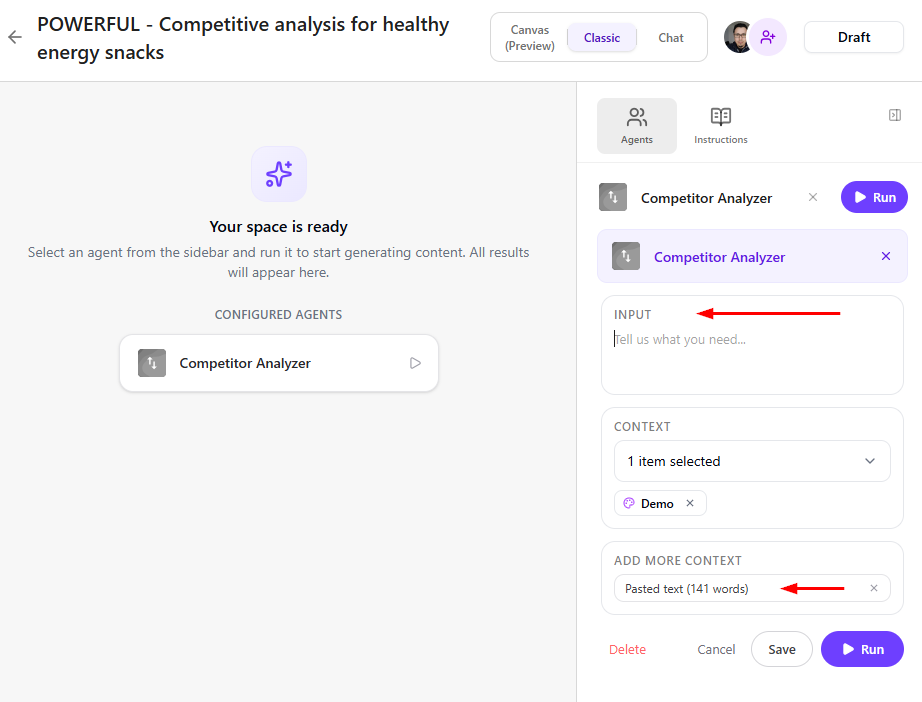
Run the Agent, and check the results by clicking the View button
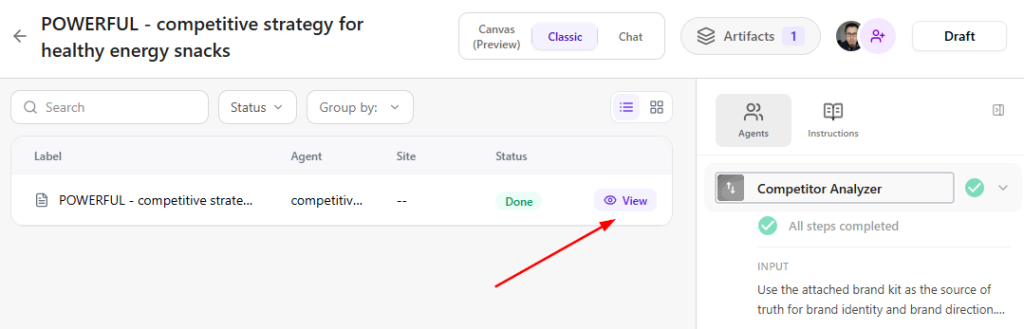
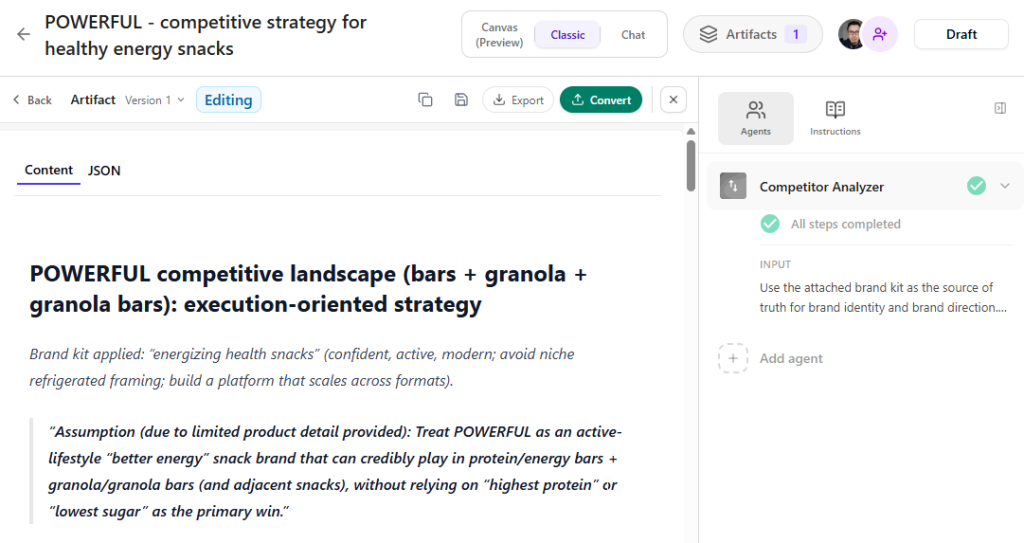
That first pass produced a strong strategic foundation. It mapped the most relevant competitors across bars, granola bars, and adjacent snack formats; ranked threats such as KIND, RXBAR, CLIF, Quest, and Nature Valley/Quaker; and surfaced a more ownable direction for POWERFUL around sustained energy, real-life usage occasions, and clean nutrition with craveability. Most importantly, it translated the research into a more usable positioning platform: “Steady energy for real life.”
Step 3: Use Market Signals to validate the strategy
Once the competitive direction was clear, the next step was to add Market Signals in the same space. The purpose of this pass was different: not to repeat the competitor landscape, but to test whether the proposed strategy was supported by actual category signals.
I used the findings from the first pass as the baseline and asked Market Signals to validate, sharpen, or challenge that direction.
In the right panel add the Market Signals Agent
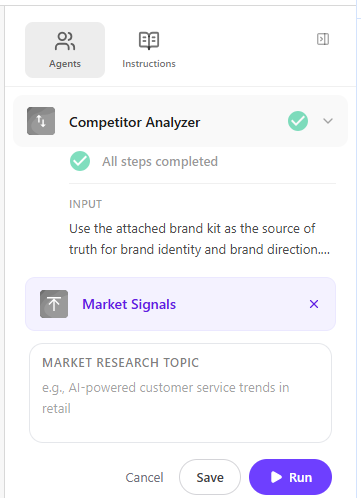
In the Market Research Topic add the following Prompt
Use the competitive strategy findings for POWERFUL as context and identify the most relevant market signals shaping the healthy energy snack category in the U.S.

POWERFUL’s current strategic direction is centered on:
- steady, sustained energy
- real-life usage occasions, not just workout moments
- bars, granola, and granola bars
- clean, recognizable ingredients
- strong taste and satisfaction
- a non-stimulant energy promise
- a potential “bridge snack” positioning for the moments between meals

I do not want a generic trend report. I want market signals that can validate, sharpen, or challenge this strategy.

Please provide:
1. The most important current market signals affecting the healthy energy snack category
2. Which signals most strongly support POWERFUL’s proposed positioning
3. Which signals create risks or competitive pressure
4. Emerging consumer expectations in bars, granola, and healthy on-the-go snacks
5. Trends in usage occasions, language, ingredients, or packaging that POWERFUL should pay attention to
6. Recommendations on how POWERFUL should refine its messaging and strategy based on these signals

Important:
- Focus on practical implications for marketers
- Prioritize signals relevant to brand positioning, messaging, innovation, and content strategy
- Avoid repeating the competitor landscape unless necessary
- Keep the output strategic, current, and decision-oriented
Then, run the agent
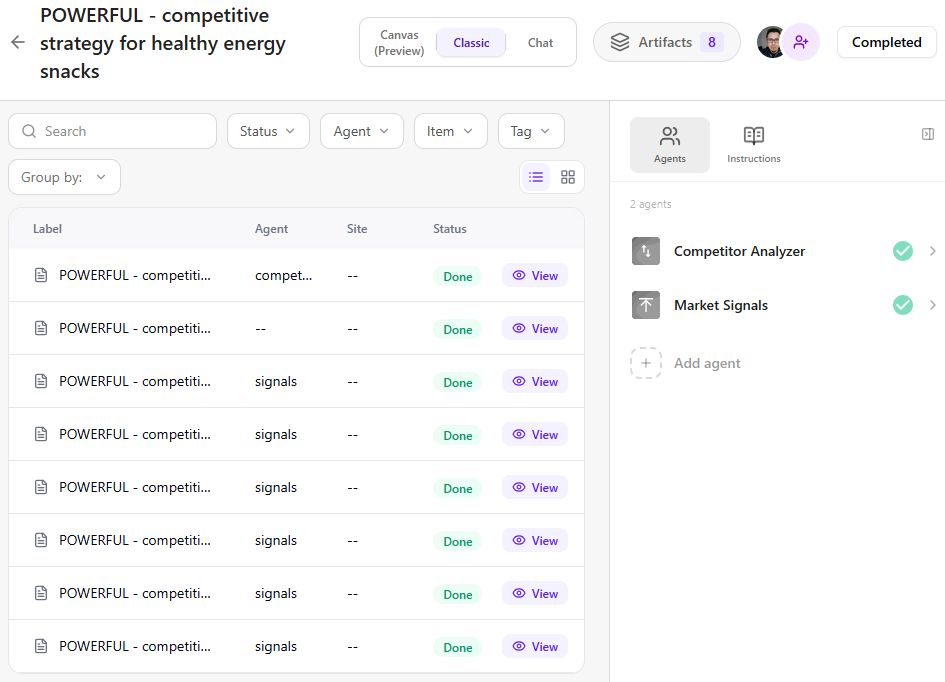
The agent will produce some Artifacts, you can review them by clicking the View button.
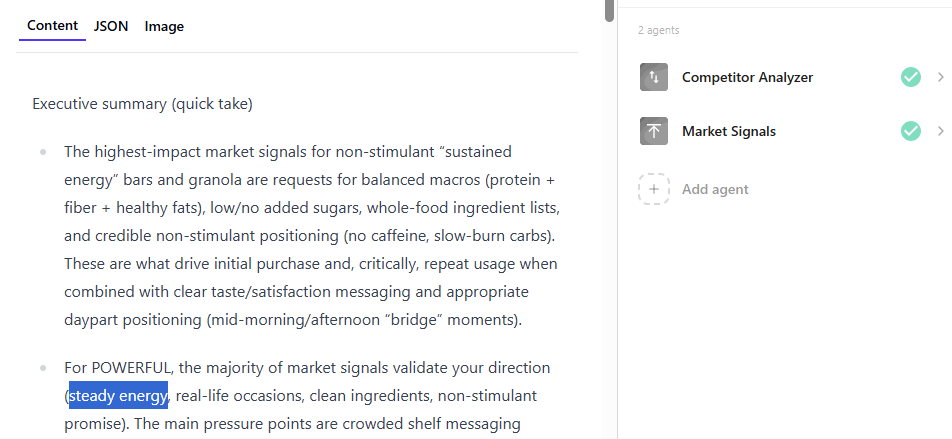
Market Signals reinforced several important findings. It supported the relevance of non-stimulant, steady energy, the growth of between-meal “bridge snack” moments, the importance of clean-label and recognizable ingredients, and the role of taste and satisfaction in repeat purchase. It also made the strategy more concrete by adding practical implications around pack sizes, occasion-led packaging cues, impulse channels, and price sensitivity. At the same time, it highlighted real risks: crowded better-for-you bar claims, competition from energy beverages, private-label pressure, and the need for specific, defensible claims rather than vague functional language.
Together, the two passes turned a broad competitor exercise into a clearer marketing strategy. Competitor Analyzer identified where POWERFUL could stand out; Market Signals tested whether those ideas were grounded in real category behavior. The result was not just a list of competitors or trends, but a more actionable point of view on how the brand could compete: by owning steady, non-stimulant energy for real-life bridge-snack moments, expressed through clearer messaging, more occasion-based content, and more specific product and packaging cues.
What the analysis uncovered
The analysis showed that POWERFUL should avoid competing on the most crowded category claims alone. Messages like high protein, low sugar, and clean ingredients are already everywhere, making them difficult to own without a more distinctive angle.
A stronger opportunity emerged around steady, non-stimulant energy for real-life, between-meal moments. Rather than positioning the brand only around performance or nutrition macros, the research pointed to a more relevant role for POWERFUL as a satisfying bridge snack for everyday routines.
The analysis also made one thing clear: this strategy only works if it is made concrete. That means pairing the brand story with more specific claims, recognizable ingredients, and messaging tied to real usage occasions.
The resulting strategy
The strategy that emerged was not to compete as just another better-for-you snack brand, but to position POWERFUL around a more specific role: steady energy for real life. Instead of leading with crowded category claims alone, the brand’s strongest lane was a combination of sustained energy, clean and recognizable ingredients, and craveable satisfaction across bars and granola formats.
From there, the messaging becomes more practical. POWERFUL can anchor its story around a core promise of clean, nutritious snacks that deliver sustained energy and satisfaction—without stimulant-heavy shortcuts, then support it with clearer occasion-based use cases such as commuting, desk snacks, training days, and mid-afternoon slumps. That direction also gives marketing a more usable framework for website structure, content themes, and product storytelling.
Why this matters for marketers
What makes this exercise useful is that it moved beyond a basic competitor list and turned research into decisions marketers can actually use. Instead of stopping at category observations, the analysis helped clarify what POWERFUL should avoid leading with, where the most credible whitespace exists, and how that can translate into messaging, website structure, and content planning.
Just as importantly, the process showed how AI can help connect three things that are often handled separately: competitive positioning, market context, and activation. In this case, the outcome was a more actionable direction for POWERFUL centered on steady energy for real life, supported by practical ideas such as occasion-led messaging, bridge-snack content, and clearer reasons to believe.
Conclusion
This exercise showed that SitecoreAI can do more than surface competitor insights. When used with the right context, it can help marketers turn broad research into a clearer strategic direction. In POWERFUL’s case, that meant moving from a crowded category view to a more focused positioning.
For marketers, that is the real value: not just understanding the market better, but using that understanding to shape messaging, content, and digital strategy with more confidence.